

We need to talk about engagement:
an explanation that starts in the brain


We need to talk about engagement:
an explanation that starts in the brain


How do we turn online scanners into engaged readers? First, let’s learn the difference — then discover how to use structure and interactivity to earn attention.


by Joe Martin and Ben Ice
by Joe Martin and Ben Ice
Interactive content improves engagement, and our new research below confirms it.
But interactive material on its own isn't enough. Content structures must meet the needs of distracted, time-poor readers. A better understanding of attention, and how readers consume online content, can bring it all together.
This guide shows you how. Let's start in the brain.


Jared Cooney Horvath is a Harvard-educated cognitive neuroscientist, educator, and author specialising in human learning and brain development.
Today, he’s explaining what our brains are doing when we’re paying attention — and when we're distracted.




How attention works in the brain
Dr Jared Cooney Horvath explains attention
Dr Jared Cooney Horvath explains attention
“There’s a little attention network right behind your left eye. Just to be simple, you can call it the frontal left brain.
“If we ever see sustained activation there? Good news. That means that person is basically just doing one thing.”
“But if we see flitting activation there? That means that person is basically multitasking, they're trying to do multiple things, and that part of the brain has to reset itself again, and again, and again.
“You’ve just got an internet scanner. Someone's just coming by to get an idea or two and get out of there.”
Understanding the wants and needs of readers and scanners can help us optimise our content for both.


Reading versus scanning
This part will come as no surprise to digital publishers: “There’s a big difference between reading and scanning. Unfortunately most people online do the latter.”
“Within a couple of minutes they go to scanning,” Cooney Horvath explains.
But that’s not necessarily a bad thing. Most readers aren’t settling in for a chapter, they’re trying to solve a problem. If we understand their needs and how to capture their attention, we can shape better stories for them, giving them reasons to stay with richer, interactive moments.
How scanning works
How scanning readers consume online text
How scanning readers consume online text
Cooney Horvath explains how scanning readers skip down through text, looking for what they’re after.
“The eye is going to go at the beginning of each line, basically, and it’s just going to jump line to line downward, looking for a key word,” says Cooney Horvath.
“If it finds a key word that it likes, you’ll then see a sideways or horizontal shift into that line, where they’re looking for two or three more things, then it’s going back to line, line, line, line.”
In 2006 (and again in 2019), the Nielsen Norman Group tracked these patterns in web content readers, mapping out the F-shaped Pattern for reading. It demonstrates the importance of front-loading content — serving high-value words early.
Your audience is scanning your content and that’s OK — if you know what they need
“If you’re a teacher in a classroom, you need sustained focus” from your audience, says Cooney Horvath.
For digital publishers and content marketers, things are a little easier. Many of our content goals — clicks, conversions, and shares — are just as achievable with scanning readers as with deeply engaged audiences. We just have to make what they’re looking for easy to find.
If readers are looking for signals, structure can become one of our most important tools. Better content design can help us structure our work clearly, in ways that are more likely to convert scanning searchers.
Reading versus scanning
This part will come as no surprise to digital publishers: “There’s a big difference between reading and scanning. Unfortunately most people online do the latter.”
“Within a couple of minutes they go to scanning,” Cooney Horvath explains.
But that’s not necessarily a bad thing. Most readers aren’t settling in for a chapter, they’re trying to solve a problem. If we understand their needs and how to capture their attention, we can shape better stories for them, giving them reasons to stay with richer, interactive moments.
How scanning works
How scanning readers consume online text
How scanning readers consume online text
Cooney Horvath explains how scanning readers skip down through text, looking for what they’re after.
“The eye is going to go at the beginning of each line, basically, and it’s just going to jump line to line downward, looking for a key word,” says Cooney Horvath.
“If it finds a key word that it likes, you’ll then see a sideways or horizontal shift into that line, where they’re looking for two or three more things, then it’s going back to line, line, line, line.”
In 2006 (and again in 2019), the Nielsen Norman Group tracked these patterns in web content readers, mapping out the F-shaped Pattern for reading. It demonstrates the importance of front-loading content — serving high-value words early.
Your audience is scanning your content and that’s OK — if you know what they need
“If you’re a teacher in a classroom, you need sustained focus” from your audience, says Cooney Horvath.
For digital publishers and content marketers, things are a little easier. Many of our content goals — clicks, conversions, and shares — are just as achievable with scanning readers as with deeply engaged audiences. We just have to make what they’re looking for easy to find.
If readers are looking for signals, structure can become one of our most important tools. Better content design can help us structure our work clearly, in ways that are more likely to convert scanning searchers.
“There’s a big difference between reading and scanning. Unfortunately most people online do the latter.”

Content design: your key to the perfect structure for your audience
Content design begins with a detailed understanding of your audience, their pain points, and how and why your content is of value to them. Armed with this knowledge, you can better plan, structure, and optimise your material.
How to optimise your material for scanning readers
- Research your audience and let the findings guide your content.
- Front-load your main message or answer at the top.
- Surface your CTAs early — whether that's a button, form, or onward journey.
- Use a clear H2/H3 structure for readers scrolling from headline to headline.
- Use media and interactive elements as hooks throughout to keep scanners engaged.
- Deliver value quickly.
Want a deeper walkthrough? Read our full guide to content design →
Content design: your key to the perfect structure for your audience
Content design begins with a detailed understanding of your audience, their pain points, and how and why your content is of value to them. Armed with this knowledge, you can better plan, structure, and optimise your material.
How to optimise your material for scanning readers
- Research your audience and let the findings guide your content.
- Front-load your main message or answer at the top.
- Surface your CTAs early — whether that's a button, form, or onward journey.
- Use a clear H2/H3 structure for readers scrolling from headline to headline.
- Use media and interactive elements as hooks throughout to keep scanners engaged.
- Deliver value quickly.
Want a deeper walkthrough? Read our full guide to content design →
Can we ‘hook’ someone’s attention?
How breaking a pattern grabs attention
How breaking a pattern grabs attention
Content creators can absolutely build in ways to grab a reader’s attention, but they’ve got to offer value, quickly.
“The best way you can hook them is just by flitting their attention network,” explains Cooney Horvath. “It won’t necessarily lead to long-term retention, but it’ll at least get them for the moment, and you can kind of do what you need,” whether that be serving up an ad, CTA, or otherwise.
Hacking attention, pattern interrupts, and breaking predictions
One way to tap into the attention network is through pattern interrupts, which, by breaking someone’s predictions, grabs their concentration.
Cooney Horvath uses the example of a television.
“If you’ve ever been watching TV, and the commercials come on, and there's just a black screen for 10 seconds because the commercials haven't started? All of a sudden you're present and you're looking at your remote, is it broken?”
Thinking about predictions, interrupting them, then rewarding the attention quickly, can be powerful.


Can we ‘hook’ someone’s attention?
How breaking a pattern grabs attention
How breaking a pattern grabs attention
Content creators can absolutely build in ways to grab a reader’s attention, but they’ve got to offer value, quickly.
“The best way you can hook them is just by flitting their attention network,” explains Cooney Horvath. “It won’t necessarily lead to long-term retention, but it’ll at least get them for the moment, and you can kind of do what you need,” whether that be serving up an ad, CTA, or otherwise.
Hacking attention, pattern interrupts, and breaking predictions
One way to tap into the attention network is through pattern interrupts, which, by breaking someone’s predictions, grabs their concentration.
Cooney Horvath uses the example of a television.
“If you’ve ever been watching TV, and the commercials come on, and there's just a black screen for 10 seconds because the commercials haven't started? All of a sudden you're present and you're looking at your remote, is it broken?”
Thinking about predictions, interrupting them, then rewarding the attention quickly, can be powerful.
Here’s how it works
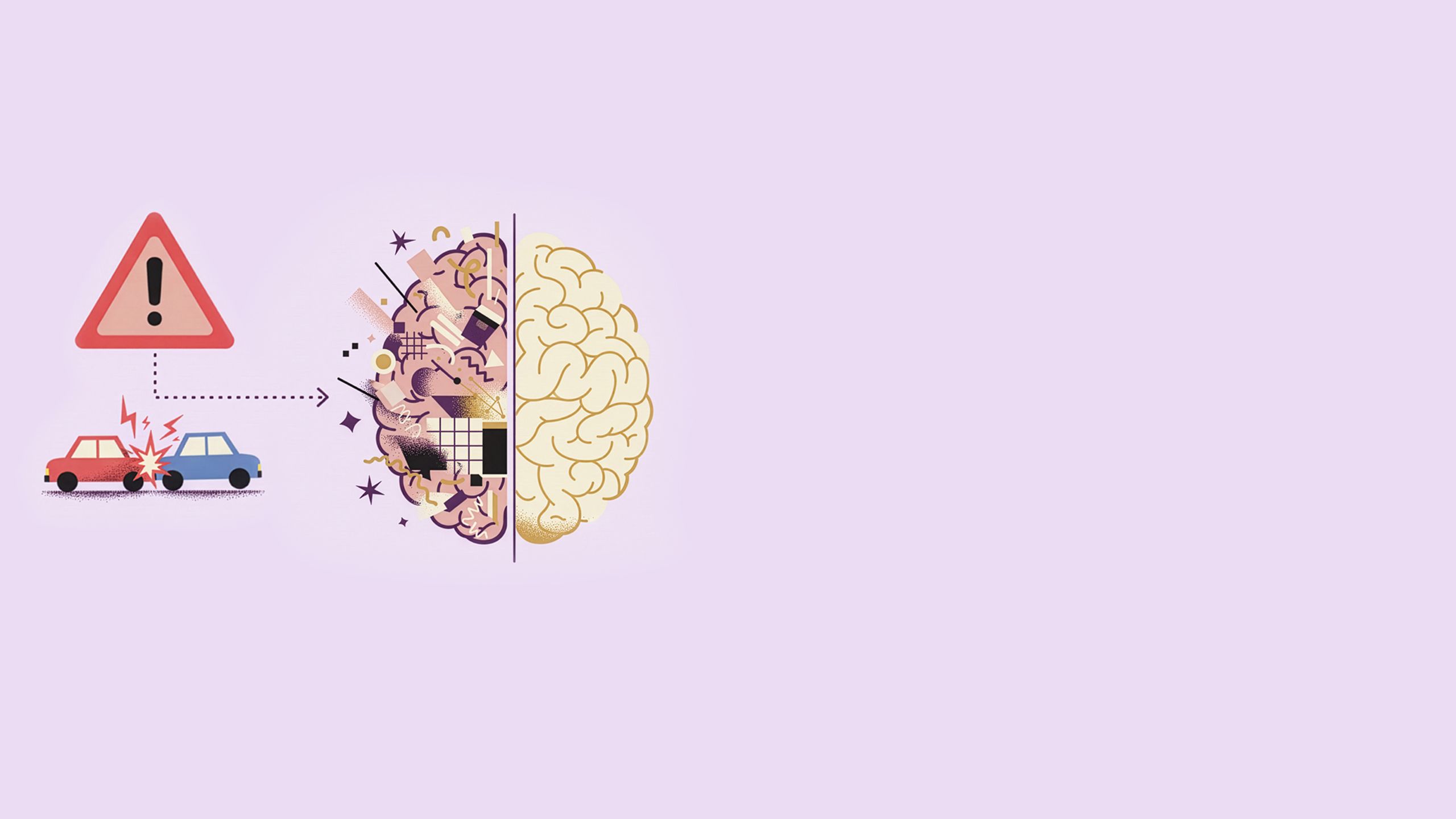
Attention in our brain is largely managed in the interaction between our dorsal and ventral networks. Focused attention occurs in the dorsal network, while running in the background is the ventral network. “This is a part of the brain that is basically paying attention to everything you’re not,” explains Cooney Horvath.
Background traffic noise while you’re sitting in a room reading? “That part of the brain will pay attention to the cars driving by, but you won’t consciously know it’s happening.”
“That part of the brain is basically there to keep you alive. If anything crazy happens in the world that you need to pay attention to, the ventral is more powerful than the focused dorsal, and it can take over, and it can say ‘Uh-oh, need your attention here.’
“One way to trick it into thinking there’s a threat is to just break a pattern.”
Changing it up, doing something out of the pattern briefly activates that survival instinct.
“The ventral network will go ‘Uh-oh, you’re about to die!’, and it will force your attention to whatever that change is."
“So one of the best things you can do is set a prediction then break a prediction, in order to trigger that network. You’ve now bought attention.”
But not for long.


Here’s how it works
Attention in our brain is largely managed in the interaction between our dorsal and ventral networks. Focused attention occurs in the dorsal network, while running in the background is the ventral network. “This is a part of the brain that is basically paying attention to everything you’re not,” explains Cooney Horvath.
Background traffic noise while you’re sitting in a room reading? “That part of the brain will pay attention to the cars driving by, but you won’t consciously know it’s happening.”
“That part of the brain is basically there to keep you alive. If anything crazy happens in the world that you need to pay attention to, the ventral is more powerful than the focused dorsal, and it can take over, and it can say ‘Uh-oh, need your attention here.’
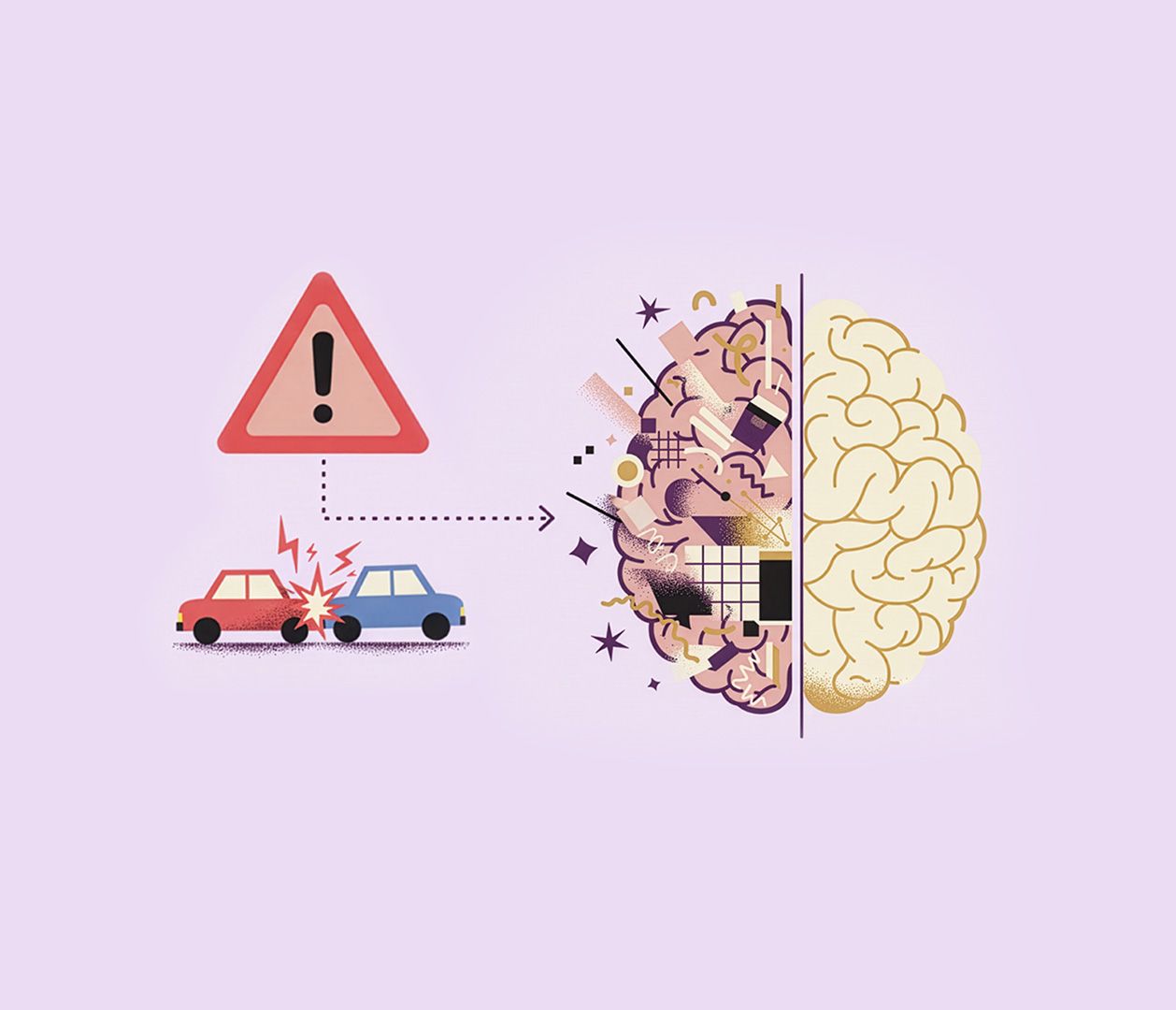
“One way to trick it into thinking there’s a threat is to just break a pattern.”
Changing it up, doing something out of the pattern briefly activates that survival instinct.
“The ventral network will go ‘Uh-oh, you’re about to die!’, and it will force your attention to whatever that change is."
“So one of the best things you can do is set a prediction then break a prediction, in order to trigger that network. You’ve now bought attention.”
But not for long.

Hooking attention in online content
Think about your media format.
“The format of a book has a very clear prediction,” says Cooney Horvath. “If you turn a page in a book and it’s upside down, that breaks the prediction. That same thing might not work on a TV screen or a cell phone screen.”
What’s predictable about the media format you’re using? Can you add something different?
But do it quickly, and give value
What sustains audience attention?
What sustains audience attention?
“The ventral network will only give you a very short window,” he says. “If you don’t give them something to pay attention to in it, they’ll go. You’ve got about 0.4 seconds to 0.6 seconds.
“If there’s something to focus on, you can then lock it in, but if it’s just a beep or a change, you’ll get their attention, then they’ll go right back to what they were doing.”
“So you need to break the pattern with something worth paying attention to.”
Worth paying attention to: deeper engagement with interactive content
So it’s our challenge as digital publishers to work even harder to secure our audience’s attention, even if it’s just for a short while. Research and industry benchmarks suggest interactive content is the way to do it.
What we know about visuals, interactivity, and engagement
Interactive elements, be they polls, quizzes, forms, scrollytelling, embedded videos, maps, or audio, tend to improve engagement.


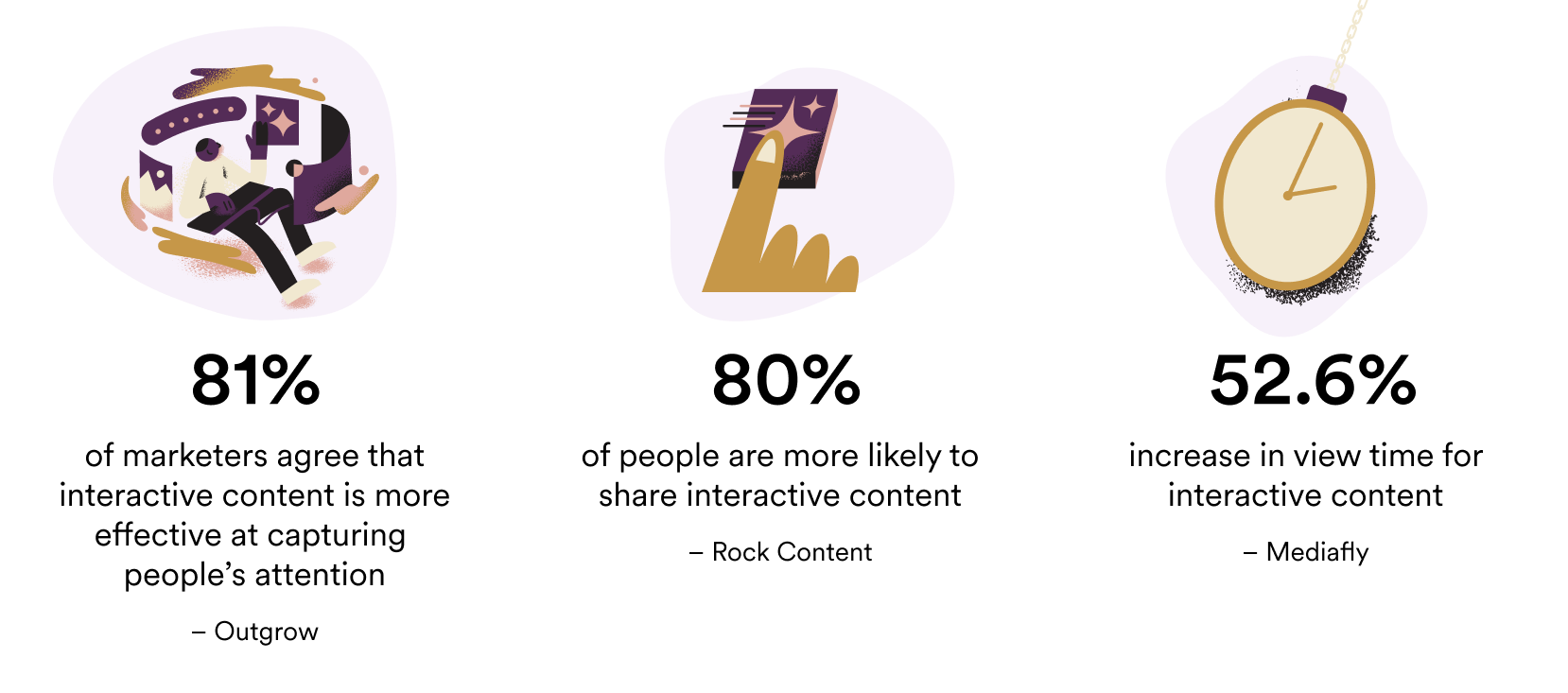
Eighty-one percent of marketers agree that interactive content is more effective at catching people’s attention than static content, according to Outgrow. Mediafly research found that interactive content boosted view time by 52.6%. Rock Content found people are 80% more likely to share interactive content with others.

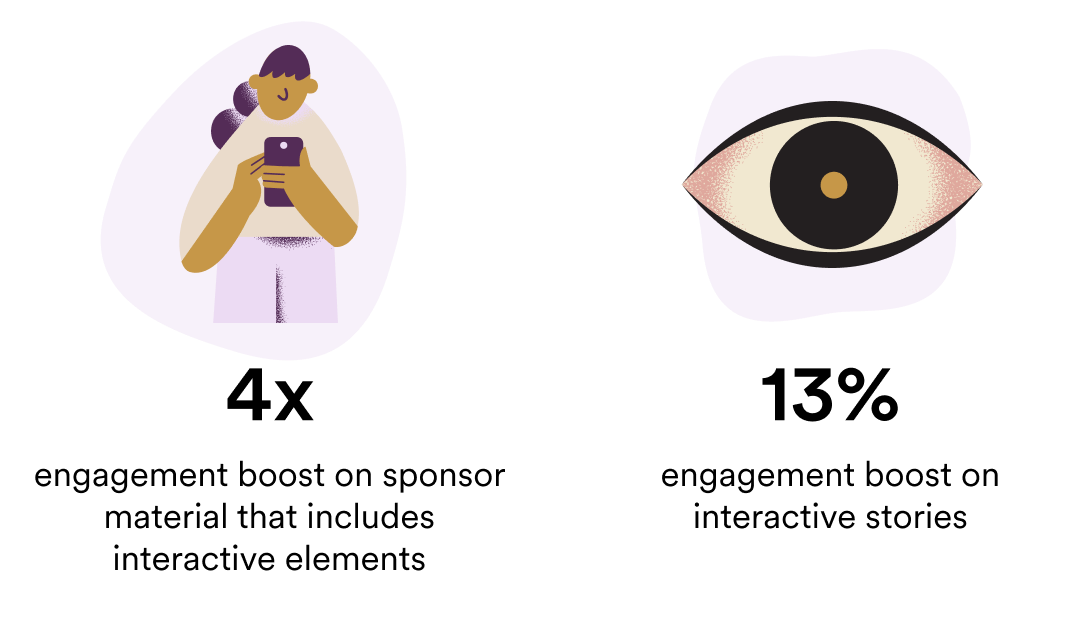
Testimonials from online publishers support this. Canadian travel brand Landsby increased engagement on one sponsor’s material fourfold in its digital magazine, which includes clickable maps and full-width videos.
Cancerfonden, Sweden’s largest cancer charity, boosted engagement by 13% on its stories and reports that included interactive elements like scrollytelling and auto-playing videos.
Measuring engagement on interactive Shorthand stories
Here at Shorthand, we can’t look into your readers’ brains. But we can measure reader engagement on Shorthand stories, and the results support the power of interactive and immersive storytelling elements.
Senior Data Scientist Joe Martin developed a single engagement measure that combines dwell time and scroll depth percentage. By combining the two, we can remove the shortcomings of each: dwell times inherently reward longer stories, and scroll depth can reward shorter stories — for which a full 100% scroll may be easier to secure than for a longform article, for example.
Let’s call it an engagement score.
Essentially this score enables us to find story examples with the best dwell time and scroll depth — then take a look at elements in common that high-scoring articles share. On a scale from 0 to 100, all stories with engagement scores above 50 we've classified as 'high engagement'.
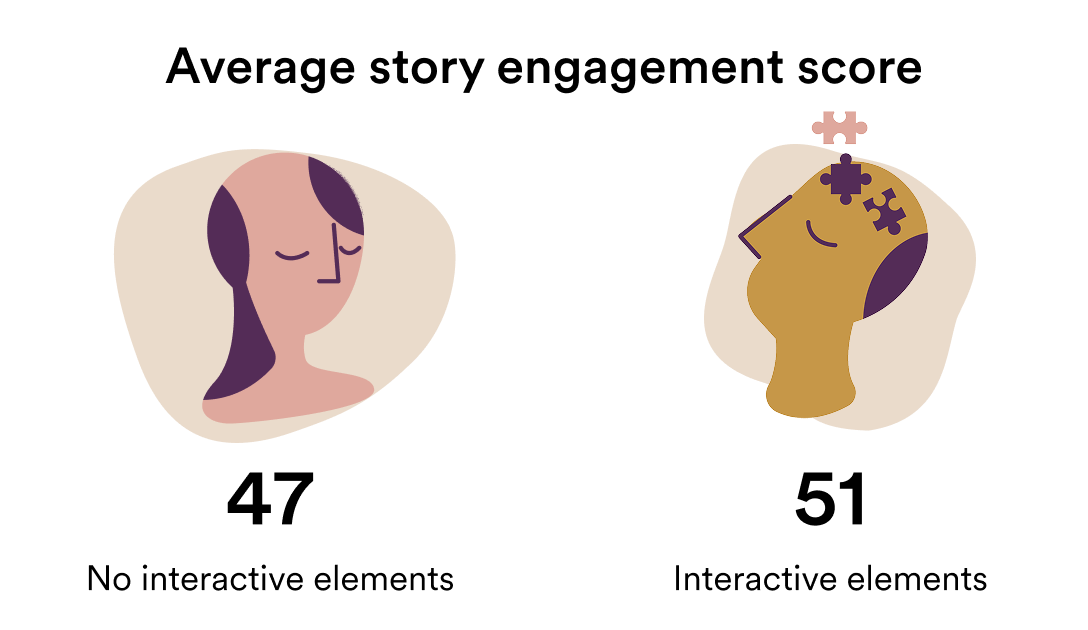
Stories that included interactive elements scored four points — or 8% — higher on average on the engagement score scale.
All of Shorthand's interactive sections appear more commonly in high engagement stories than in low engagement ones.
These sections include Background Scrollmation, Chart, Media Gallery, Two Column Scrollmation, Scrollpoints, and Reveal.


The average engagement score for stories with interactive sections was above 50, placing them in the ‘high engagement’ category.
Stories with high engagement:
five immersive examples
Murky Waters:
Navigating the Risks of China’s Dual-Use Shipyards
This investigation by the Center for Strategic and International Studies opens with movement to capture attention early, as a full-width video zooms down from a satellite view to a ground-level look at a shipyard.
As the reader scrolls, they are told a brilliant data story, with interactive, animated charts that break down complex materials to help visualise and compare the scale of China’s shipbuilding production.
Interactive elements:
- full-width, auto-loading video
- scroll-animated data visualisations
- click-and-drag image comparison overlay
- Background Scrollmation
- Media Gallery
- ‘hover for detail’ diagram icons
Starring UCL:
A journey through UCL’s appearances on the big and small screen
This fun celebration of University College London’s historic campus architecture starts with a magazine format that is broken up with movement and embeds. The story revisits the moments UCL’s halls, libraries, grand entries, and streets featured as film and TV locations. Readers are treated to background video, and embedded film scenes and social media posts. Hercule Poirot, James Bond, and Batman (well, Bruce Wayne) make an appearance in this brilliant article.
Interactive elements:
- embedded video
- embedded social media posts
- Reveal sections
- Background Scrollmation
- Related Stories section
In the last minute
Brentford FC’s interview with Jota Peleteiro blends video and written memories of one iconic goal.
Shorter than the other examples in this section, it still manages to deliver a kick with its illustrations, bespoke designed statistics, brand colouring, and embedded, auto-playing video.
Interactive elements:
- embedded video
- Reveal section
Armas españolas en la guerra de Ucrania: dónde, cómo y quiénes las usan
For ‘Spanish weapons in the war in Ukraine: where, how, and who are using them?’, El Periódico Spain invested significant design into a military-themed scroller.
One highlight is the arcade-game-style control panel, in which readers scroll through photos of military hardware and supporting information.
Interactive elements:
- Reveal section
- video embeds
- animated map
Save the Redwoods League Annual Report 2024-2025
An interactive, scrolling map helps readers visualise the scale of a year’s work by this environmental organisation. The report gets its human side through inspiring imagery of the community group at work, and its beautiful forest landscape photos.
Interactive elements:
- scrolling map
- Reveal section
- embedded podcast episode
The takeaways
- Structure your content so scanning readers can find value quickly: Front-load your high-impact material and constantly work on your knowledge of your audience.
- Use interactivity and visuals to boost engagement and performance.
- Consider breaking patterns, but only to spotlight something valuable.
- Measure story engagement with the tools at your disposal, then iterate.
Understanding how attention works in the brain can help us get creative about our material and the way it’s absorbed. But we can’t trick our readers into engaging. At the end of the day, it’s up to us as storytellers to understand our audience and our medium and produce work that suits. As Cooney Horvath confesses when explaining prediction breakers:
“You’ve got to figure out: What are people expecting to see? Give them a little bit of that, and then give them something different…
“What those specific things are? Man, I've got no clue.”

 Built with Shorthand